Showing posts with label healthcare. Show all posts
Posted by Pattie on 1/31/2011 08:43:00 PM

This month, I am participating in a ReVolution! -- Every Monday in January I plan to write a blog post here about my life and how Health at Every Size℠ has changed my life for better. This is the fifth and final installment of five.

IDENTITY, STIGMA AND HEALTH AT EVERY SIZE℠

Erving Goffman is said to have looked through newspapers and magazines every day, clipping items that helped him shape his ideas about how people interact with each other. Several key elements emerged in his writing.

First, he noted that people anticipate how others will view them and seek to manage that view through action, gesture, dress and facial expression. He called this "impression management." He suggested that this thing we call our "self" is actually a multitude of "selves" that are created in the moment of interaction with other people who are also presenting their "selves" in an attempt to manage our impression of them. In essence we play parts like in a play and we change our behavior and our presentation based upon who we are with and how intimate we are with that person. Questions of trust, authenticity, desire and control inevitably become part of the mix.

It is this background that helped Goffman develop his ideas about social stigma. He defined social stigma as a "spoiled identity." He suggested that those who are stigmatized by others are limited in their ability to manage impressions. When we are stigmatized, those who would view us through a single lens do not let us show them multiple layers of abilities, character traits, desires, etc. To stigmatize is to control another and to prevent them from having a useful and fulfilling social relationship.

Here's how it works. If I am stigmatized and I do something that fits the stereotype of my stigmatized social identity, I am used to prove the truth of the stigma. If I do something that is different from the stigma I am regarded as being inauthentic, faking it or trying too hard. I cannot escape the stigma and show my authentic self, or manage impressions that move away from the stigma.

Most of what has been done about stigma since Goffman has missed the point. Efforts are made to help individuals who are part of stigmatized populations to cope with the stigma and rise above it. This usually only serves to reify the stigma not end it. If stigma is to end, it must be ended by those who are stigmatizing. It is telling that English is so convoluted at this point. We do not really have a word for those who stigmatize. Bigot, maybe, but that can evoke a history that one might not want to evoke. Stigma is often regarded as the "right" attitude to have.

For example, there is a kind of reasoning that suggests that stigmatizing fat is correct because fatness is a result of laziness and a lack of self-control on the part of the person who is deemed fat. Fat people are placed into a cardboard, flat group that assumes all individuals deemed a part of the group are alike and, indeed are lazy and lacking in control. These are the only things that matter about the fat person. A fat singer, a fat Ph.D., a fat scientist, a fat physician, a fat athlete and so forth cannot exist as just a singer, Ph.D., scientist, physician, athlete. The word fat as an adjective changes the identity of the noun into something less than human.

But most people do not regard this as bigotry. This stigma is regarded as not only good but as necessary to help the fat person become thin. The stigmatizer is seen as "caring" about the "health" of the fat person.

But the stigma translates into a self-fulfilling prophecy with discrimination leading to reinforcement of the stereotypes. Fat people are insured less often and therefore put off going to doctors and getting health care, which leads to them become sicker. Fat people earn less money, making it harder for them to adequately acquire clothing and other symbols that suggest competency or diligence. Fat people are pushed to social backstage, which leads other to assume that they are unhappy with their bodies. And, of course, almost all fat people have tried to get thinner, which reinforces this belief as well.

Here's the problem. Stigma limits the life chances of human beings. It doesn't improve health. It makes it worse.

Stigma creates stress and stress creates imbalances in our physical and emotional well-being. There is ample evidence that stigma is a predictor of ill-health and there is growing evidence that this may have to do with a physiological change that surprise, surprise, leads to all those conditions that are associated with and are supposedly caused by being fat.

So I could sit here and make a health argument at this point, citing articles and studies. But I want to make a different point with this post.

Stigma is also a bad things to do to another human being. It is controlling and limiting the freedom of people. It shuns and shames people. In a word, it is just ain't right.

So I'd like to suggest in this last installment that the reason to embrace Health at Every Size℠ is because it is a stigma-free approach. Instead of treating a person as being less than human because of their size (and by the way, this happens to people on the thin end of the spectrum as well, not too mention people are considered too short or too tall), HAES℠ celebrates all bodies. Instead of dividing humans into acceptable bodies and unacceptable bodies, HAES℠ opens the door to people being judged on what they do, not what they look like.

To me, this is the most important reason to embrace HAES℠. Health is relative and there can be much debate on what is and is not good for a person. But dignity, empathy and diversity are not debatable. So often fat people, even fat activists, get caught up in justifying their existence by outlining how healthy one can be and still be fat. But that is not the issue. The issue is that weight-focused health care is stigmatized health care.

My favorite slogan, which has been co-opted from the disabilities movement is "nothing about us without us." A real test of public health policy as well as personal health care is the extent to which the voice of the patient is heard. Fat people are silenced by medicalization of their natural variation.


So listen up world. We do not need help. We do not need a cure. We do not need to be changed. We are that perfection. We have dignity. We are human. It really is that simple.


And that, to me is the essence of Health at Every Size℠.

This month, I am participating in a ReVolution! -- Every Monday in January I plan to write a blog post here about my life and how Health at Every Size℠ has changed my life for better. This is the fourth installment of five.

HEALTH AT EVERY SIZE℠ AND THE LIFESTYLE POLICE --
(OR WHY HEATH AT EVERY SIZE℠ IS IMPORTANT TO PEOPLE OF ALL SIZES)


John Kennedy did implement the President's Council on Physical Fitness, which offered students rewards for various achievements in phys ed. I remember winning badges for things like long-jumping and running 100 yards (I had the second best time in my school for a girl in 11th grade). But there was not a lot of rhetoric connecting the physical fitness program with specific diseases and the question of public health. Since the 1970s, "fitness" has become more and more about policing behavior and personal responsibility, not about the joy of movement or the achievement of milestones.

What shifted in the 1970s with the physical fitness craze that led to the 1980s shift into funding lifestyle programs rather than prevention programs, was a fundamental understanding of health. The Baby Boomers seemed to have got it into their heads (as a group) that they could control their health. Jogging became a national past-time. Gym memberships rose. The belief that it was a good idea to do some exercise every day for general well-being became a quest to ward off all diseases. If we just ate the right foods, got the right amount of exercise, didn't smoke, didn't drink, and was conscious about nutrition, we SHOULD NOT GET SICK. EVER!!!

Of course, what that meant is that the poor souls who do get sick are suspected. Catch a cold, you didn't build up your immune system. Had an accident, you didn't stretch well or warm up in exercising. Contracted cancer, well it was obviously something you ate. Have a heart condition, your diet must be laden with, well depending upon who is speaking, too much fat, too little of the right kind of fat or if you eat correctly then it must be your Type A personality.

What started off as a system of promoting general well-being became a blame-the-victim game that has basically divided the population into haves and have-nots of health.

And of course, couple this with fat prejudice (as well as other kinds of prejudice) and a ready-made excuse for bigotry is woven into the culture. Believe that all fat people are lazy, ugly or dirty (the usual bigoted indictments of "other" groups), that's okay, you just care about their health.

This mechanism is, of course, not limited to fat people. Everyone with lung cancer is suspected of smoking. Everyone with AIDS is suspected of sexual "perversion." Liver disease means you must have drank too much. And so forth.

The new part of that rhetoric is "costs" -- almost daily someone somewhere publishes a report that shows how much the bad habits of others are costing everyone.

At the heart of this rhetoric lies two assumptions that need to be examined:

  1. We have control of our health.


  2. We are personally responsible for our own health and no one else's.


I believe that these two assumptions are patently false, though each with a grain of truth (as most lies need in order to be believable).

It is true that we have influence over our health and if we do things to excess (including exercising too much or restricting our food intake and obsessing over it too much), we will hurt our bodies in the long run and as we get older in the short run. But we do not control our health in full.

One of the original fitness gurus, Jack LaLanne died last week at the age of 96. He live a long and exceptional life, but the fact is he still died. He didn't die healthy. He died. Of course, a lot of people are pointing to LaLanne's life as an example, but I suspect that genetics played a bigger role in his longevity than his supporters would like to admit.

Jim Fixx was one of the thought leaders in the fitness craze of the 70s. He was a well-known runner. He died while running at the age of 52 from a heart attack. In truth, given that heart disease ran in his family and his father died in his early 40s, Fixx may have added some years and even quality to his life through his running. But he died young just the same.

The point is that there are a huge number of factors that determine health: some are under one's influence, most are not. To decide that Jack LaLanne had the superior fitness program over Jim Fixx is to pretend that we are masters of more than we have a right to claim.

Who cost the health care system more? Fixx died young, supposedly sparing us from his old age and the care he would need. LaLanne needed heart valve surgery at age 95. Was he a burden to the system because he prolonged his life until his valve needed care? These are absurd questions, but they are the kinds of questions to which the lifestyle think and victim blaming of current rhetoric lead us.

That leads to why the second assumption is also bogus, but with a grain of truth. We live in our bodies and in those bodies only we know what it feels like. We know our pain and we know our joy in ways that no one else, even our most intimate of lovers can really know. We do owe ourselves care and loving ourselves is, in part, about taking care of ourselves.

But health is not singular. The air we breathe we share. The water we drink we share. Every plant and animal that becomes our food is affected by that air and water as well. We share the planet with bugs. Some of those bugs do us good and some of those bugs under specific circumstances do us ill. We like to think of our bodies are singular, but in fact we have colonies of other creatures who share our body and some of those creatures like the bacteria that lives in our intestinal tracks are necessary for us to function. Where do we end and the bugs begin? Where do we end and the air begins? Where do we end and the water begins?

Carl Sagan once wrote, "We are star stuff." We are the elements and we will return to the elements. All matter does.

This inter-connectivity means that some health problems are better solved at a level different than the individual. Politics, pollution, climate, economics, personal relationships, stranger relationships, historical and sociological contexts affect our health and well-being.

We cannot calculate the cost of the contraction of disease without making some really big and fallacious assumptions. We are assuming that whatever condition or disease that is being examined is preventable and that the incident of that disease could have been prevented. This is always an estimate and it is always speculation.

Calculating the cost divides us and presents some of us as a burden to others of us.

And calculating the cost assumes a set price for our health that is never negotiable or questionable. Health "costs" do not occur spontaneously out of the mouth of some god somewhere. "Costs" are "charged" by people for services supposedly delivered to other people. Want to reduce costs? Charge less or pay less for medical services.

So how does Health at Every Size ℠help us with this understanding of health and the current lifestyle police mentality that essentially want to fault and make victims pay for their "crimes" against the healthy.

The Association for Size Diversity and Health offer 5 Principles of HAES℠:

  1. Accepting and respecting the diversity of body shapes and sizes.


  2. Recognizing that health and well-being are multi-dimensional and that they include physical, social, spiritual, occupational, emotional, and intellectual aspects.


  3. Promoting all aspects of health and well-being for people of all sizes.


  4. Promoting eating in a manner which balances individual nutritional needs, hunger, satiety, appetite, and pleasure.


  5. Promoting individually appropriate, enjoyable, life-enhancing physical activity, rather than exercise that is focused on a goal of weight loss.


Accepting that people are diverse is a good beginning. Jim Fixx was a different person from Jack LaLanne. Both of these men were a different person from my great-grandfather who lived to be 99 years old, weighed 300 pounds when he died and probably never ran a mile in his life (though I'm quite sure he did his share of physical labor on the farm).

Personally I'm glad the world is full of diversity. I'm easily bored and without the wonderful diversity among us, it would be a really boring place.

Health and well-being are multidimensional and we sometimes choose one thing over another. I like playing poker. But I hate second-hand smoke. Even so-called non-smoking poker rooms are full of smoke because they are rarely cut off from the rest of the casino. I could not play daily, but I enjoy it enough to take the smoke every once in awhile. The exposure is limited but I know it is damaging just the same. Life is full of dimensions and complexities and no one can really draw a straight line of cause and effect with most health-related experiences.

The principles laid out are simple. They suggest that promoting well-being should be about acceptance not creating restrictive and constrictive rules that probably will not have the intended impact.

At the heart of these principles is a belief that all people deserve to be given a chance to show what they are made of -- all people deserve dignity.

The lifestyle policing and cost analyses come from a position of power and control. They are not about good health but about passing the burden on to someone else. They are about blame.

So perhaps you think that because you are average size or smaller this is not an issue for you. Well, the lifestyle think is what drives health care costs. Pre-existing conditions are a brainchild of this way of thinking. Dropping your insurance when you get sick is "only right" in a world where people are to blame for their illnesses. More and more companies are demanding fitness tests of their employees. Better not get too many colds because your boss might decide you ate too much candy or didn't work out enough and compromised your immune system. He will be able to fire you because you are costing the company too much in labor costs and insurance costs for having that cold.

The really sad part of this myopic view of health is that the real problems of pollution, poverty and daily stress are not being addressed. By ignoring the real problems we are making them bigger. You may be worrying about losing weight today, but ignore pollution and global warming and your children may be worried about how to find food for you in your old age.

Adopting a Health at Every Size℠ view of the world can contribute to a broader understanding of health and the major factors that contribute to health as well as creating a more just and sound basis for addressing those factors. Allowing fat people (or any group) to be scapegoated in the name of cost-cutting and blaming will open the door to anyone being blamed for their illness or disability.

First They came... - Pastor Martin Niemoller

First they came for the communists,
and I didn't speak out because I wasn't a communist.

Then they came for the trade unionists ,
and I didn't speak out because I wasn't a trade unionist.

Then they came for the Jews,
and I didn't speak out because I wasn't a Jew.

Then they came for me
and there was no one left to speak out for me.

This month, I am participating in a ReVolution! -- Every Monday in January I plan to write a blog post here about my life and how Health at Every Size℠ has changed my life for better. This is the third installment of five.

HEALTH AT EVERY SIZE℠ AND GETTING OLDER


When I first decided in late 2000 to quit dieting once and for all, I was chronically ill with what I thought at the time was lupus (and have since learned was probably sub-clinical hypothyroidism). For the most part, these symptoms were chronic but not debilitating on a daily basis. I had flare-ups but had settled into routines that seemed to work. I had some sort of pain almost daily but usually dull pain and with regular exercise and eating good food and getting plenty of rest, I felt generally healthy.

I spent the first couple of years re-learning my hunger and satiation cues. I had dieted so much that I literally did not know when I was hungry or what my hunger felt like. In the past, I depended on outside cues to tell me when to eat and how much to eat. This was a process of mindful eating and, frankly, trial and error. I often waited too long at first, feeling ravenous when I finally sat down to eat and then finding I ate so fast that I was full long before I realized it. I slowed down my eating, learned to savor food and learned how to identify hunger before it was starvation.

In December 2002, I got pneumonia and became very weak. It was months before I could walk without gasping for air. I found a great program that started me working out in water with paddles and eventually I was doing 20 minutes on the treadmill and weight training in the gym. I became stronger and my metabolic health was excellent (blood pressure, blood sugar, cholesterol, pulse rate, etc.). AND I didn't lose weight or gain weight.

By the Spring of 2004, I felt the healthiest I had in years. I was still dealing with arthritic symptoms and flare-ups but not as often and not as severe. When we went on the road in The Ample Traveler, I felt good and maintained that feeling for some time. I turned 47 that summer.

It was easy to believe in Health at Every Size℠ under those conditions. When I wrote Taking Up Space with Carl, I was confident and had no doubt that this was a better way of living than the 30 years I spent fighting my body's natural tendency to be bigger.

I sprang my foot in 2004 and had nerve damage that left me walking with a cane, but even that didn't slow me down or shake my confidence. I had so much experience with chronic conditions at that point, that it became just one more thing to care for with my body--an annoyance, but my view of health had long since changed into an understanding of relative health rather than a set criteria. So I felt I was the healthiest I could be with chronic conditions.

Then I turned 50 and the "other biological clock" for women started. I became menopausal, I started having metabolic problems and I went through a rough period with Health at Every Size℠.

The same conditions that are supposedly connected to fatness are connected to aging, especially in women going through "the change." I began to doubt my choice to not diet and spent many days thinking through the whole process. I felt alone in some ways because I had fat-acceptance friends who were talking about how healthy they were and I knew I was not healthy. In fact, it felt like at the time that I was turning into the poster child for all the conditions that they were bragging they didn't have. For a while I kept quiet. I didn't write here and I didn't reach out. I didn't diet, but my reason for not trying to lose weight was that I was thoroughly convinced that it would not work, that I wouldn't lose any weight. I had been down that road and it made me sick and I didn't want to get any sicker. But I wasn't sure about the new road and whether I'd feel better.

I did reach out to some private groups eventually and I began to see that fat women who were going through menopause and who had type 2 diabetes and other metabolic problems were using HAES℠ to help them deal with their conditions. I started reading about these conditions and discovered that there were strong indications that the dieting I had done for 30 years as well as the aging process probably contributed to those conditions.

Let me be clear about another aspect of this. It didn't help that I had little access to health care due to no insurance and it didn't help that I am an underpaid teacher who has to work several jobs to supplement my income in order to be able to teach. Stress doesn't help. Stigma doesn't help. Fear doesn't help. Isolation doesn't help.

So about 2 years ago, upon realizing that many of my health problems, including the chronic conditions that started in 1997, were probably from hypothyroidism,I had another epiphany like the one I had in 2000. I had been misdiagnosed because of the societal and cultural attitudes about fat. In 1997, when I first got sick, I had chronic fatigue. I couldn't sleep well. I caught one infection after another. I was oversensitive to light and had rashes from exposure. I had an abnormal ANA count. I felt like I had the flu all the time with my joints and muscles aching. It wasn't hard to understand why the doctor thought it was arthritic and sent me to a rheumatologist, who, like most specialists, diagnosed me within her paradigm. Thus, lupus.

Except there was one symptom that I ignored and my doctors ignored: I gained 90 pounds in about 6 months. At the time, my paradigm and my doctors' paradigm was calories in/calories burned. I was eating less because I was too sick to eat much, but I went from someone who rode a bicycle everywhere she went (lived 3 miles from school, so at least 6 miles on school days, probably about 30 miles a week total) to someone who was bed-ridden. It seemed obvious that was the reason for the weight gain.

However, rapid weight gain is a symptom of hypothyroidism and no one even explored the possibility at the time. Hypothyroidism mimics lots of other conditions, especially so-called "check-box" conditions like lupus (positive diagnosis for lupus comes from presence of 4 out of 11 symptoms plus elimination of other possibilities).

So as I face an aging body, I've come to realize that my aging process is affected by several factors: hysterectomy (not ovaries) at age 38, untreated hypothyroidism, and years of yo-yo weight gain and pushing my metabolism and immune system to its limits.

In the past year, armed with this new understanding of HAES℠, one that doesn't depend upon me being perfectly healthy to demonstrate its effectiveness, I have become more pro-active in my health care.

First, I bought a wrist cuff to monitor my blood pressure. This has resulted in a significant reduction of my blood pressure meds and a personal realization that my blood pressure and pulse are heightened when I go to the doctor. I take my basal temperature in the morning to monitor the hypothyroidism. I check my blood sugar often. I am faithful in taking my medications and supplements, including menopausal support. I use assistive devices without hesitation because they improve my stamina and overall health.

And most importantly, I continue to practice intuitive eating and try to move my body as best I can. I do not diet. I do not weigh. I do not worry about my body size. The truth is that under thyroid treatment I think I may have lost a little weight (judging from how my clothes fit), but that is an effect of taking care of my thyroid and not intentional.

I am not the spring chicken I once was and I am angry that much of my health was taken from me by cultural standards and socialization that has made my aging more difficult. But the answer cannot lie in now buying into that thinking. I believe with all my heart that if I tried to lose weight now, I would make matters worse. I believe with all my heart that dieting is not good for the health. I believe with all my heart that I dieted my way into disability and early aging.

I believe with all my heart that if I had known and practiced Health at Every Size℠ when I was younger I would be a much healthier 50+ woman.

I tell my story often because I hope it serves as a lesson for others. I told Sarah on the podcast this week that I was excited to see so many young people involved with fat acceptance because they might be spared the years of dieting and the effects of that dieting.

I think that history will look back on this period as barbaric when it comes to dieting and weight loss. We have abundance and resources and instead of celebrating and sharing that abundance, we have created generations of people afraid of food, afraid of our own bodies.

I have come to realize how strong my body is. I have abused this body and fought this body for years and it perseveres and even improves with love and care. As I have researched what dieting does to a body, I have come to realize that I could be dead now from many of the things I did in the name of "getting more healthy."

So let me affirm, right here and right now, that I may not be the usual poster-girl for HAES℠, I should be, because HAES℠ has saved my life and has made me stronger. Health is relative and has a multitude of factors contributing to one's daily constitutions. But given what I've had to fight and what barriers I've faced and what damage I've staved off, I am healthy at my size.

Posted by Pattie on 6/02/2010 02:28:00 PM

So I'm excited that there is a new resource on the web for People of Size.

And I'm very exited to be blogging there:

Why Are We Letting Michelle Obama Off So Easy?


I'm going to try to blog over there at least once a month.

I highly recommend the website.

Posted by Pattie on 2/15/2010 08:21:00 AM

The Obamas are following the Clintons down the road of Health Care Reform and while I had hopes that it was not true this time and I've been impressed with how much further they have gotten, I'm have a feeling of deja vu all over again. I fear that if the stalled health insurance reform does ever get restarted again, it will end up being exactly what the monied interest in health care want: mandatory purchase of health care without or with few restrictions on profit-making at the expense of our health.

But what really is giving me the willies is last week's "Let's Move" campaign "targeting childhood obesity." Does anyone remember the timing of the "Shape Up America"? There stood Hilary Clinton standing behind C. Everett Koop near the end of 1994 while he announced that what America's health care needed the most was for doctors to tell their patients to lose weight like no doctor before 1994 had ever suggested to a patient that weight loss was a good idea. Wait. 1994! Hilary Clinton! Could it be that this was a smoke screen to take the focus off her and her husband's failure to fight the monied interest and give Americans a universal health care system?

Now we have a stalled health care reform that has been watered down to create the same racket we have with car insurance, except that living is something we have a right to and driving a car is a privilege (remember the Declaration of Independence? LIFE, liberty and the pursuit of happiness). So either way, I smell smoke and I see mirrors -- don't look over here where deals have been made with the profiteers. Let us misdirect your attention to the horrors of fatness. Except this time, we'll add the good old, "do it for the kids" line and that way you don't have to worry about the fact that after 16 years of telling Americans to diet and most Americans trying to diet, we still have fat people. What's worse, we managed to kill a bunch of people from the drugs and surgeries in the name of losing that fat along the way.

My more liberal friends are taking a gentle approach. They see something well-meaning-ed in Michelle Obama's motherhood and are gently asking her to consider alternatives. I'm not so inclined to let her off that easily. There's too much data and too much history and too much context to just assume that she is miguided. This is the same ole, same ole and I think it's time to shout from the roof tops: "The Emperor and (the Emperess, in this case) have NO CLOTHES!"

But I don't want to stop there. I do not like negative politics and I do not want to echo the Nopublicans in their negativity about everything these days. So on the off chance that Michelle Obama is sincere in her desire to make life better for the next generation and the generations to come, let me put 7 practical and feasible alternatives on the table that would be better at improving the lives of our children than putting them on a diet and making them exercise to the point that they forget how much fun it is to just play:

7 PRACTICAL IDEAS THAT WOULD MAKE LIFE BETTER FOR GENERATIONS TO COME

1. SAFER FOOD AND DRUGS

Our food system is superior in many ways, but the ever growing greed in food production is leading to more and more mishaps from contaminated food to preservatives that are bad for us to frankenfood to the lack of basic foods in poorer neighborhoods with less nutritious foods in their place. In fact, I suspect that many of the sins laid on the doorsteps of "obesity" have more to do with safety of our food than it does with how much we are consuming of it. In addition, more and more people are dying from their medications, including children. Reform at the FDA is needed and I haven't heard one word out of the administration regarding this.

2. SAFER PLAYGROUNDS AND STREETS

Children still grow up in areas where staying at home and watching television helps them live longer than being out in a playground or playing in the streets near where they live because it is dangerous to be in the streets. (Last time I checked, gunshot wounds or being assaulted were not good for your health.) Schools are closing earlier and earlier. In a world where ecommuting and working at home is more possible than ever, we are still insisting that the 9 to 5 work day is optimal and thus we have latchkey kids with no place to go and no safe adults to be near. This is not a matter of playing police. This is a matter of it takes a village to raise a child. Our communities are not child-oriented. They are profit-oriented. If we wanted to create a village where children could move, they would move. Children do not need to be told to play. When they are safe to do so, they move. And by the way, targeting fat kids is going to make this worse, not better. Bullying kids that are different is one of the ways that the streets are unsafe. Blaming fat kids for their health problems is going to fuel those differences and give ammunition to those bullies. In fact, it turns the federal government into one of those bullies.

3. STOP POSTPONING PAYING THE BILLS UNTIL THEY GROW UP

Deficit spending is putting a burden on the next generation and the ones after that. I'm not just talking about government debt. We had a major meltdown of the "credit industry" 2 years ago and our response was to patch it up and keep it. We have been sold a pack of lies about credit, especially long-term debt. Debt used to be something we entered into until the crops were harvested and then we paid it back with an eye on savings in bumper crop years. Now we are told it is okay to buy our toys on credit. The wake up call is that some day it has to be paid. We hit the snooze button instead of making the hard decisions. That has delayed the collapse of an unsustainable system, not fixed it or bailed it out. All of these things means that it is just going to be a bigger problem for our children. If we really loved our children we'd be re-examining this entire economic system and making some deep and abiding changes in our economy.

4. SPEAKING OF DEBT, GET RID OF BORROWING FOR STUDENTS

Nothing screams "I hate my kids" more than student debt. We put pressure on kids to go to school. We design jobs so that a high school education isn't good enough. Then we make it impossible for them to pay for that schooling without first putting themselves in debt. They leave the starting gate with a burden to carry. This burden makes them wage slaves, pure and simple. Now we are adding to this burden by making it impossible for them to finish the "4-year" degree in 4 years. Overcrowding and cutting back on teaching continues to create a system where students will have to borrow more to finish that degree.

5. SPEAKING OF EDUCATION, MAYBE TEACHING SOMETHING OF VALUE

Student debt isn't even the biggest problem in education. With the "No Child Left Behind" legislation we have made schools less about learning and more about test-taking. Our educational system is creating automaton sheeple, not critical thinking citizenry who question systems in order to improve them. If we really wanted life to be better for our kids we'd teach them how to think about their lives and the social systems within which they live so that they could improve things. Nothing belies the fear that adults have of their kids' brains than the way we do education and nothing points out the lie of "doing it for the children" than this fear. If we truly want them to have a better life than we have, then we should prepare them to be reflective thinkers instead of sheeple.

6. STOP STARVING THE CHILDREN

The real tragedy of the "Let's Move" campaign is the extent to which America's children still are suffering from malnutrition, starvation and lack of food security. Children are dying from lack of food and we are emphasizing starving the ones who have food? How crazy is that?!?

7. REAL UNIVERSAL HEALTH CARE

It is long past the time for America to provide health care to its citizens. Children growing up under the "for-profit" health care system are not going to be as health as they would be if they were able to see a doctor without fear of breaking the family bank. There are plenty of preventative measures that will ensure they grow up health that have nothing to do with the size of their bodies that need to be available universally. The hodgepodge, committee-fied bills that are being "reconciled" in committee right now are not going to cut it without a public option. As long as health care is a "for-profit" enterprise, money is going to be more important than our children.

Let's be clear about some things:

I voted for Obama. I did not vote in 2000 or 2004 presidential elections because I saw no viable candidates for whom to cast my vote. I liked Obama's message of change and wanted to give him a try. I had hope that he might be different and I think there are some ways that he has been different.

But I am not as pleased as I hoped I would be and this latest campaign weakens my hope even more. This is nothing new. This is business as usual in Washington and all those things he said in his campaign about continuing down the path of business as usual will come true, even if it is cloaked in the language of change.

We pay a price for those things we believe that are not true. Taking public resources and emphasizing weight loss for children is going to have a heavy price tag. We are going to raise a generation who fear their own bodies, who stigmatize fatness and fat people and who will spend their adulthoods sorting out food issues instead of solving more important challenges. In addition, spending these public resources on this means that we take away resources from more important challenges facing us now. We pay now. They pay later.

We do need a change. The "Let's Move" campaign is not change.

Posted by Pattie on 1/26/2010 06:10:00 AM

Bevin Branlandingham wrote a beautiful piece on The Queer Fat Femme Guide to Life about her personal loss caused by Phen/Fen fiasco in the 1990s.

In a side note, I tried to find a study of iatrogenic problems with weight-loss drugs, which I suspect account for a lot of medical mishaps and this was all I could find.

Where is the outrage?

Posted by Pattie on 11/20/2009 11:33:00 AM

An extremely timely article from Slate regarding the complexities of stigma and health when it comes to fatness. Turns out there is ample evidence (pun intended) that stigmatizing a population may lead to the poorer health outcomes, co-morbidity and mortality associated with the so-called disease of "obesity." Can you say spurious? I know that you can. (HINT: stigma is the alcohol, fat is the water)

From the Slate Article:

If anti-fat bias can affect our bodies, then it's worth considering how an all-out war on obesity plays out in terms of public health. When we reach out to poor communities and educate them about the risks of being overweight, we are, in effect, exporting the weight stigma that happens to be most prevalent among rich, white people. Indeed, Rebecca Puhl says the reported prevalence of weight discrimination has increased by two-thirds since the mid-1990s, while media coverage of the "obesity epidemic" has quintupled over roughly the same interval. (Meanwhile, the U.S. diet industry has just about doubled its annual revenues—to nearly $60 billion.)


The bottomline is what many of us have been saying all along. Public Health Policy should be promoting HEALTH AT EVERY SIZE not a war on 2/3 of our population!

Posted by Pattie on 11/08/2009 07:45:00 AM
Labels:

In a sense, Health Care Reform in the United States took a giant leap forward yesterday. No comprehensive, universal health care plan in the US has ever made it this far.

The vote was 220 to 215. Very close. And it came with a price that may have been too much to pay.

Don't get me wrong. I'm happy it passed. But I think what the 5 vote margin suggests is that the money being spent by the insurance industry and other interested parties came dangerously close to working in spite of strong popular support of needed reform.

The really sad part is that in the overall picture of what needs to be done to improve health care in the United States this is a baby step towards a baby step. We really are barely crawling here.

But I do believe that there is no hope of anything significant happening unless the current reform passes into law. My greatest fear is that this has been made so hard to do that once it is done, everyone will pat themselves on the back and go home, satisfied that something has been accomplished. But in the interest of allowing the baby to crawl first, I'll wait to post on what I think needs to be addressed next after universal access.

AND, to keep things in perspective, a lot has to happen before that current reform passes into law.


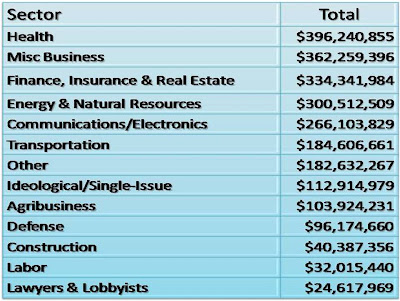
The only thing we can be sure of at this point is that even in this so-called bad economy, a lot of money is going to continue to flow in Washington. According to OpenSecrets.org, health related industries continue to lead lobbying efforts in 2009. Money that should be used to pay for health care for their clientele is going to be used to fight these bills. Where do these companies get all this money? From sales of premiums and drugs (services and products, just like every other business). That fact alone ought to tell us what's wrong with current access system. These businesses have enough extra money in their coffers to spend billions fighting this legislation.

I plan to be contacting my Senators frequently over the next few weeks.  I hope you will consider doing so as well.  We need to remind them that we will remember their vote on this come election time.  We also need to follow-through on this promise to remember. 215 representatives yesterday said our health was less important to them than their financial gain. We should not forget their names or their selling-out of our lives.

This is a moment in American history that should be remembered for a long time to come and those who would waste our time, money and health need to be held accountable.

Posted by Pattie on 9/17/2009 03:38:00 PM

Mary Whorley at Whorley Dervish shared Rachel Maddow's School of Crock segment (those of us over 35 know the reference). She writes:

The Republicans were there so that Baucus would have plausible deniability along the lines of "the Republicans made me do it," which is politically less damning than "I did it for my corporate masters."

This is a game that has been going on in our two party system for years. The Republicrats owe their livelihood to big corporate interests (Read carefully -- I mean both sides of the aisle). Baucus did what he did because he was well paid:

The Montana Democrat is enjoying this largesse — some $3.9 million in contributions from the health care industry since 1989 — principally because of his place as chairman of the Senate Finance Committee. The panel is at the center of this year's health care debate, and on Wednesday Baucus released his view of how the medical system should be reshaped: an $856 billion, 10-year package of changes.

The stream of generous campaign contributions from doctors, drug makers, hospitals and other medical interests didn't stop at the chairman's door. It extends to the other members of the so-called Gang of Six, the two Democratic and three Republican senators who labored with Baucus since June to produce what he hoped would be a bipartisan bill. All have received above-average donations from the health-care world.

...

Among them, the six senators have raised $10.7 million since 1989 from the industries and people with the most at stake financially in the overhaul effort. That's an average of nearly $1.8 million apiece over that period, more than triple the roughly $560,000 average for all other senators and representatives.

Read More

So the acid test is here. Now that we have bills going to both chambers. There is a way for good health care reform to still pass. It would have to be fast and it would NOT be bipartisan. But it could happen. If the Democrats have the balls and really mean it, they can do it.

If they don't do this. If they pass the Baucus bill and not the house bill or something closer to the Baucus bill than HR3200, then they never meant it.

We need to hold the Democrats and Obama accountable.

Posted by Pattie on 9/14/2009 05:22:00 PM

Well the good news is that I haven't had hives a lot, the black cohosh & progesterone cream are helping (not totally, but the hot flashes are down to only a couple a day and not constantly) and I have more work than I know what to do with.

The bad news is I find myself neglecting the fun stuff like writing here and journaling at home and taking a moment to care for myself or spend time with my husband. Oh yeah, and, well, more work doesn't seem to equal more money. But what's new with that.

Here's the big news of the month. My husband finally had a doctor tell him what's been wrong for the past year. He has been diagnosed with fibromyalgia. It is good to know what it is. It is good to finally have a doctor take him seriously. But after the initial relief of having a name, we are now coping with the fact that this isn't going to go away easily and the quick karma that comes with fibromyalgia.

I was diagnosed with this condition in 1997. I've done a lot of reading and a lot of research and I've learned to understand my own body better. In the past couple of years I've come to understand the underlying conditions that led to my condition -- specifically, I have come to believe that the source of much of my problems has been hypothyrodism. I was originally diagnosed with lupus and had many of the symptoms associated with lupus when I started getting ill. But now that I am testing positive for hypothyroidism and have read more and discussed the situation with my doctors, I think the lupus was a misdiagnosis. I believe I had subclinical hypothyrodism.

Our conditions lead me to ponder two big stigmas in health care & health research in this country.

First, is fatness. No one regarded my gaining a considerable amount of weight in a small amount of time in 1997 as a sign that my thyroid was growing weaker. It was decided then that because I was in pain most of the time and had lost the energy to ride my bike the 20 miles a week that I had before, that my lack of exercise led to the 90 pound weight gain in 5 months. Looking back with more critical eyes (it wasn't until 2000 that I started questioning so-called medical science regarding weight), I now realize that probably didn't make much sense. Because hypothyroidism is connected with weight gain it is under-reasearched and under-treated.

Second is gender. Deciding that because something is predominantly diagnosed by one gender or another it becomes a "woman's disease" or a "man's disease" is problemmatic, espcially if doctors remain misinformed. It took 4 months for me to be diagnosed with fibromyalgia. It took Carl 12 months to have the same diagnosis even though his symptoms were much more clearly defined and obvious (especially in retrospect). Expectations of pain and manhood along with the decision that fibromyalgia is a woman's condition really got in the way of what is a very simple diagnosis--a touch test of 18 points on the body. It was a year of negative tests and being told he was just "getting older" before a doctor did the test. The eventual diagnosis took less than 2 minutes.

As we contemplate health care reform in this country, a lot of debate has taken on a "blame the victim" tone. I actually heard a doctor today say on "Talk of the Nation" that health care professionals would take better care of their own bodies if they weren't so busy taking care of lazy people who do not do what they should to prevent their health conditions. Yep, doctors are too busy doing important stuff to eat right and exercise, but the rest of us are just lazy. I turned off the radio at that point, screaming a few explitives.

Stigma doesn't help anyone. Lifestyle and prevention methods have their place, but they are not the solution nor the problem. Stigma will do more to kill than these other issues and the answer isn't to shame others into a better lifestyle.

Posted by Pattie on 8/27/2009 09:35:00 AM

Wendell Potter is my new hero. I saw him on PBS with Bill Moyer and now he has been featured on a NY Times OpEd. If you believe our current system works and that a public option isn't necessary, I suggest you read about Wendell Potter and also Linda Peeno.

Both of these whistle blowers tell eerily similar stories about the insurance industry. We are currently at the mercy of these megacompanies and their policies.

Here's a taste of their stories:


Posted by Pattie on 8/14/2009 08:23:00 AM

I just saw this posted in a forum (I will refrain from attribution because I don't want to debate the person, but the ideas):

GOVERNMENT RUN HEALTH CARE:
The compassion of the IRS
the efficiency of the Post Office,
at Pentagon prices.


Without pointing out the immediate fallacy (no one is advocating "government run" care -- oops, pointed it out anyway) this is my response:

CURRENT AMERICAN HEALTHCARE:
The compassion of Wall Street,
the efficiency of American Auto Makers,
at Hollywood Blockbuster production costs


Medicine is never going to be a free market because the knowledge and care needed at the worst possible times in our lives is complex. Those charging for these services are always going to have the upper hand. Free markets allow for buyers to shop, to refuse to buy, to obtain the best knowledge. Without consumer protection and a power player in the market that evens the playing field, we are at the mercy of the sellers in the worst way -- the consequences of not buying is death, disease and disability.

I happen to believe that it should be universally and singularly funded so that we have one representative for the people who negotiates the purchase of services for all humans (this is the Canadian system and having been a part of it for several years, I found it to be working fairly well). But I'm a realist and I don't believe that such a system would be possible at this time. Too many stakeholders with too much to lose.

What is a close second is what is being proposed by Obama and is being semi-fulfilled by the various bills being considered in Congress: make one of the players in the market a force to level the playing field.

What I find most disconcerting is that many of the criticisms that are being leveled and fears being expressed about government involvement in health care already occur in our system, just through the private sector.

This is my top seven list of misconceptions:

1. Everybody pays for their own health care.

If you have insurance, you are paying for everyone else in the insurance system -- the concept of pooling funds to cover the risk for a few is the basic concept of insurance. Excluding millions of people from the pool isn't very smart unless the people you exclude from the pool are the ones most at risk, thus, insurance companies do not want you in the pool if you are a child, if you are an older adult, if you have a pre-existing condition, if you have are at-risk because of family history or personal behavior, and, increasingly, if you get sick.

2. No one should have to pay for those who do not qualify for insurance.

One of the reasons that health care entities charge so high is they have to cover the visitors to emergency rooms and facilities who do not pay either through bankruptcy or through simply not paying all or most of the bill. This not only costs the entity the money spent on the time and equipment to provide the service, but also the staff time on social services or collection services at attempting to get the bill paid. The net result of this is that those who have insurance pay more than they would otherwise because they are paying for these overhead costs.

3. Doctors and nurses should decide on care, not bureaucracies.

This ship sailed in the mid-80s. Your medical decisions are being directed by nameless, faceless decision-makers who "qualify" your care through your insurance company. If they refuse to pay, you most likely will not receive care. The job of the decision-maker is to find whatever reason possible to deny care in order to maximize profits. Most the reasons they find are NOT medical reasons. They look for some little thing in your application that they can use to cancel you policy (btw, they do NOT refund your premiums when they "discover" these discrepancies). The number one complaint that most medical professionals have regarding the current system is that they cannot spend the time or provide the best care to their patients under the current system. This is why nurses, especially, are solidly for health care reform. They see the results of this system every single day.

4. If the government becomes a major player, we will lose the efficiency of the free market.

We currently have the most inefficient and costly system in the developed world. Fully 25% of our health care "costs" are due to the enormous administrative burden of going through the qualification process the each insurance company has. Most doctors offices now employ at least one staff member who does nothing but paperwork and sit on the phone all day working through the bureaucratic mess of private insurance.

Our emergency rooms are places of the biggest medical mistakes because they are clogged with people who have no where else to turn for care. In inner cities, airborne communicative diseases spread faster because of these centralized places for the working poor to gather when they are sick to sit for hours and hours of exposure. We are one big disaster away from the whole thing breaking down.

The current system is extremely inefficient and is getting worse. We are starting to see the results. A recent book asserts that medical professionals are misdiagnosing about 15% of the time.

5. The current system allows the freedom to get medical care without interference from bureaucrats.

This one is especially used by those who would scare older persons with the so-called death clause. Well, every single HMO that I've studied or been a part of has "end of life counseling" already. I'm asked every time I go to the doctor or hospital about whether I've set up a living will. The current profit motive is going to push and push us to consider opting out of their paying for care at every turn. This is not a medical issue. This is not a moral issue (you know, care for your loved ones by planning ahead, it is the right thing to do), this is a profit issue (tell your doctor to turn off the machines so we can collect from you and never have to pay out). Personally, I'd rather have this be a matter between you and your attorney and not be asked when I'm sick, but if people are sure that this is a government thing, they need to pay attention to this long-standing practice by the HMO.

This does raise another issue that I think is more important. Does universal health care mean anybody can get any medical service they want covered. The answer is "no" and has to be "no" because otherwise we will be giving free reign to medical providers to invent crappy medical interventions. Oh yeah, we already have that -- its called "fee for service" and only a government player in the system is going to push for an incentive that doesn't include keeping us sick in order to get more money out of us. In truth, this may be the only thing HMOs have been good for in the past 30 or so years, but because of their own profit motives, they found out that they like us being sick too -- that way they can refuse us coverage when the moment comes while keeping our premiums.

6. The current system is good for business

It is plainly not. Some of the business failures we have seen in the past few years have been in part due to the rising costs of health care coverage for employees and pensioners. The only business that the current system is good for is the HMO/insurance industry and the pharmaceutical industry. I mentioned in a comment on an earlier post, it is my belief that if we continue with the current system, we are going to see the United States lose ground in the world economy (and may be seeing this already). Outsourcing from other countries, moving of factories to other countries and brain drain exits of college graduates to other countries are all motivated in part by the rising costs of health care.

7. Our system is the best in the world, why mess with it?

Yes, we have more bells and whistles than most places. We do love our technologies. However, most of the time our technology drives up costs without producing much in the way of improved health. The fact is that we rank out of the top 10 in a number of health indicators such as life expectancy and infant mortality. When put in a per dollar perspective, we really suck. We spend more, receive less. We are not the best in the world and the best in the world are systems that have their governments involved in some way.

Posted by Pattie on 8/11/2009 09:11:00 AM

Carl has a list of books he'll never write which includes one called the "Mononarrative," which would be about the trend in American public discourse that has been going on for 20 or 30 years. The idea seems to be that we should all be repeating the same narrative and that composing a text or subtext that doesn't confirm to this one, true narrative is unacceptable. It's not that everyone agrees upon the content of the mononarrative, but everyone seems to agree that there should be a mononarrative.

"Since coming up with the term, I've seen the expression 'monomind' in my readings," explains Carl, "and it parallels what I've been thinking very well."

Of late, Carl has been suggesting that there is a new discourse afoot -- he has called it the "No-No Narrative." Those in power no longer want anyone talking, including themselves. They just want to shut down discourse.

"The motto of the 80s and 90s was 'You're not supposed to say that,'" Carl further elaborates, "while the motto in this decade has been 'NO talking.'"

I couldn't help notice over the weekend how eerily similar the "spontaneous protests" popping up at town hall meetings on health care were to the "Brooks Brothers Riot" from the 2000 election. I went looking on YouTube for videos of both events and found that Rachel Haddow beat me to the proverbial punch:


I agree with Rachel's take at the end. The best way to fight this stupid form of shouting down politics is to point it out for the orchestrated power mongering that it is and make it so obvious that no one will want to do it again. Shouting down is not debate and shouting back isn't the way to create a debate. We must fight the no-no narrative by telling our own stories and by unmarking and taking away the incentive for this kind of government by riot.

Posted by Pattie on 8/03/2009 09:47:00 AM

I've been amused and frustrated at the discussion about last week's Paul Campos interview over at Alas, a Blog and I've thought about several responses.

I could get in on the discussion about the politics of fatness. Personally, I don't think any mainstream political perspective is doing right by fat people. Liberals blame so-called "Big Agriculture" or "Big Food" for fatness, which is essentially painting fat people as mega-consumers, who mindlessly obey their mental and physical impulses. This paternalistic attitude fundamentally sees fatness as an illness, or at least, a social ill. The fact that they don't directly blame fat people is irrelevant. We are still stigmatized and flawed for being fat. That is not fat acceptance. Conservatives are perfectly happy to ignore the health and well-being of fat people while using us to support opposition to the liberals, specifically, staying in the pockets of Big Ag, Big Food, Big Pharm and Big Insurance, by suggesting that our being fat is all our fault -- "personal responsibility versus public interest." So fat people will cost too much for the health care system, so let's not reform health care. Libertarians have questioned some of the methodologies for demonizing fat and have even provided forums for fat acceptance writers to share their points of view, but in the end, the stance of the Libertarian is not usually fat acceptance but rather that the government has no business telling us to not be fat. They still mark fat people as being flawed, they just support our right to be flawed.

I could join in the discussion about what is and isn't fat acceptance. Personally, I believe fat acceptance is fundamentally the belief that people come in diverse sizes and that fat, in and of itself, is not a sign of illness, mental deficiency, moral deficiency or lack of fortitude (will-power). Fat is fat. Some human beings have more than others. It is a physical characteristic and shouldn't be debated or discussed any more than we would if we were talking about eye color. Fat should not be the basis for discrimination as much as any other physical characteristic should not be the basis. Just treatment of people involves not judging on the basis of the how they look, period. Thus, deciding that whether people who look one way will cost the system more than "beautiful people" is a basically unjust discussion.

But I haven't posted these thoughts there because I can't get past one little aspect of the whole discussion: Debating costs is a smoke screen.

While we continue to debate the questions of cost, we continue to pretend that cost is immutable, fixed objectively without any room for scrutiny. That it is just is. After all, people in the medical system have to be paid, don't they?

The BILL for my little surgery in June has grown to around $4500. This is what I'm being BILLED, NOT what it COST. Why was the hospital emergency room the only place this could be addressed? Why did I have to see several doctors to have it addressed? Why did I have to come back to the hospital to have the bandages changed and see a burn unit nurse twice? Why did my just stepping into a hospital mean I was going to be billed over $1000?

When we have discussions about health care costs, we keep confusing billings with cost. Right now hospitals bill whatever they want (as do clinics, doctors, pharmaceutical companies, laboratories, testing centers, and so forth). They often do not get what they bill because the HMO, insurance company or government program says, this is what it should cost and pay only that. Then the hospital tries to get the difference from the patient. Sometimes they do, more often they do not. That is part of the why the bill is so high in the first place.

You people who have health care coverage think you are paying for your own care only? You are already paying for all the people who can't afford it and you are doing it in a system that allows the medical provider to decide how much they want to charge in the first place. You already subsidize others, you are just doing it in the most inefficient and costly way possible and making the health care oligopoly rich in the meantime.

Let's be clear. No market forces are going on in health care. A market requires the ability for consumers to walk away. When you or your loved ones are sick, you cannot shop around. You aren't able to pick and choose. You can't decide to delay purchase until later. You can't buy low. If you can't get the health care that you need at a doctor's office or clinic, you head down to the emergency room where you know that you most likely will not be turned away. The hospital knows this as well and that is why they charge $4500 to lance an infection. They know that I'm there because I have no where else to go. This is a decided advantage of which they take are only too happy to take. In any other economic circumstances, we would label this "price gouging" and make it illegal. This is why traditionally health care providers have only been too happy to have a number us not have access to funding. We are the reason they can price gouge. We are desperate enough that they can charge what they want.

I heard someone say one intelligent thing the other day in the health care "debate": In all other instances in the Western world where health care reform has occurred, it historically had to be done in spite of the cost. Once it was done, the costs were reduced BECAUSE of the reform. There used to be a time in this country when government or public control of natural monopolies was a good thing. Health care is a natural monopoly and it can and should be regulated just like electricity, gas and water used to be.

But one part of the health care reform debate to remember is that discussions of "costs" always have to be tempered with the knowledge that what we call "costs" are essentially price gouging. The best way to reduce those costs is to regulate the market so that those who are in a position to gouge will not be allowed to do so.

Posted by Pattie on 7/30/2009 04:02:00 PM

And this is why Carl and I were happy Paul wrote the preface to our book:

America's Moral Panic Over Obesity

Posted by Pattie on 7/30/2009 09:24:00 AM

PREFACE

I knew it was going to happen...

The health care reform debate has finally got around to blaming fat people for the nation's health problems.

I've been avoiding thinking about this and writing about this because, well, it's tiresome. This is something that I see so clearly and it is obvious that the majority of Americans (and really the rest of the western world, or at least, English speaking world) just can't see. I hate the disconnect. I feel like I've seen and I've written clear and concise arguments over and over again only to have the exact same questions asked and the exact same rebuttals made. These questions and rebuttals are phrased in such a way that it is obvious the person posing them has not heard/read and/or understood a word on the clear and concise argument.

Ever spent time with a three-year-old who has discovered the word "why"? You speak and the response, no matter what you say, is "Why? Why? Why?Why? Why? Why?Why? Why? Why?Why? Why? Why?Why? Why? Why?" By the end of the "conversation" you are thinking "Why do I bother?"

Or in the words of Mugatu (Will Ferrell) in Zoolander: "I feel like I'm taking crazy pills."

So with this extremely impatient introduction let me make an argument for why the last thing health care reform needs to do is try to make people lose weight and why Health at Every Size (HAES) is the best preventative care option for containing health care costs AND making our country healthier.

TOP 7 REASONS FOR
MAKING HAES THE ONLY PUBLIC HEALTH POLICY ON WEIGHT


7. Almost every method for losing weight ends in weight gain.

There is no viable way for taking weight off and keeping it off for the vast majority of people. In fact, there is ample evidence (pun intended) that dieting and weight loss schemes may be one of the reasons that Americans are larger than they were 20 years ago.

6. Almost every method for losing weight has led to dire health consequences in long-term health outcomes.

Most weight loss schemes, including so called "sensible" ones often lead to poorer health outcomes for individuals who temporarily succeed at them. Drugs are often pulled off the market within a few years of introduction due to disability and death caused by them. WLS has some of the highest mortality and comorbidity rates of any surgery done on a regular basis. Severe calorie restrictions and various appetite suppression schemes cause all sorts of short-term and long-term health problems. Not only is there no proven way to lose weight permanently, there is no proven safe way to lose weight.

5. There is precious little evidence that being fat CAUSES any disease

Yes, there are correlations. But there are correlations between being male and certain diseases and no one is advocating castration for cures. There are correlations between being of African descent and certain diseases and no one is advocating skin lightening as curative. Three conditions must exist to show cause and effect:

First, the cause has to take place in time before the effect. Since figuring out when a disease started (diagnosis is always after the start of a disease), it is often impossible to know which came first, the weight gain or the disease.

Second, a change in the cause should produce a change in the effect. This correlation has been established on a population level. We have gotten fatter over the same period of time that we have, as a group, experienced more heart disease, diabetes, high blood pressure and so forth. But establishing the population correlation isn't the same as establishing individual correlations. For example, little evidence exists that losing weight in a particular individual leads to a change in their health conditions, especially when we consider the third condition to establish cause and effect.

Finally, NO OTHER EXPLANATION has to be available to explain the relationship between the cause and effect. So, in the case of weight loss, since most people trying to lose weight often change diet and/or their physical activity, the actual change in eating and/or exercise may be the more plausible explanation for changes in health associated with weight loss. Since precious few have actually studied or questioned the "cause and effect" aspects of weight with any kind of rigor, at this point we do not really know what the relationship between weight and disease are. We only know that over the past 30 years, people have gained weight and prevalence of certain health conditions have increased. We are far from establishing cause and effect and this is true no matter how many times people get on TV and say "obesity causes..."

4. We know that stigmatization contributes to ill health.

Any "program" that promotes weight loss is stigmatizing fat people. I know that is a radical thing to say, but it is true. Weight loss as a goal means getting rid of fat and it requires a demonization of fat in order to make it a goal. Fat carries stigma in this culture. Weight loss reinforces that stigma. Any public health policy that makes weight loss an overall PUBLIC goal is going to perpetuate stigma. That means even with accessibility, fat people will not receive the proper care they deserve either because some medical professional is going to concentrate on weight loss instead of the health condition OR many fat people, having been shamed or unwelcomed in medical settings is going to put off going to see a health care professional until it is too late. Thus, continuing to stigmatize fat is going to lead to worse health outcomes, not better ones.

3. We do know that exercise has a beneficial effect on individual health no matter what their size.

Health at Every Size promotes the idea that we should be pursuing health NOT weight loss. So here's where I know that the proponents of obesity as health crisis do not really care about the health of fat people and do NOT believe their own assertions about how to lose weight. Most HAES professionals advocate that to become healthy, all individuals should eat well-balanced foods with good macro and micro nutrients and should move their bodies more. Most weight-loss gurus recommend pretty much the same thing -- changes in eating and exercise to achieve weight loss. SO, if the weight-loss gurus believe that these lifestyle changes will lead to weight loss because of the physics of calorie consumption and conduction, why are they worried about HAES? If they are correct and we encourage persons of all sizes to eat well and exercise regularly, then fat people would lose weight, right? Does it actually require the fat persons active measurement of weight to lose the weight? No. If they are right, the weight would go down whether the person is weighing themselves or not. So if I were truly wanting to promote weight loss and I heard that a bunch of fat people were willing to exercise and improve their diets, wouldn't I be happy to just let them do it? Wouldn't I be elated that they got the message? But the opposite is true. Weight-loss gurus are threatened by the HAES movement. I believe that is because most of these people who say they are concerned about the health of bigger people have no such concern. What they want is more money, more prestige and more power for themselves. HAES as a health policy concentrates on providing encouragement for persons of ALL SIZES to take good care of their bodies. Fat acceptance means no more stigma of fat persons, which means that a fat neutral world would encourage healthier lifestyle practices.

2. HAES would mean better health for thin people too

By concentrating on weight rather than health, especially in children, the health habits of many so called "normal" weight and "underweight" persons are ignored. Since size = health indicator is so prevalent, the naturally thin persons often believe they are okay eating what they eat and not exercising. By paying attention to behavior instead of a physical characteristic, all persons will be encouraged to pursue healthier lives.

1. HAES will work to improve health where weight loss will not

There has been one study done in all the years of weight research that actually asks this question about success. Linda Bacon did a 2 year study running two groups, one that dieted and one that practiced HAES. The results were what any chronic dieter could tell you. Those who concentrated on losing weight were in poorer health at the end of the two years. Those who concentrated on improving health regardless of weight, were healthier. One study does not make a conclusive case, of course, but it certainly supports the need for further study and promises hope where most weight loss studies do not.

REAL PREVENTATIVE HEALTH CARE

The question of health care reform is a complex one and I agree that preventative health needs to be a part of the equation to cut costs and to ensure success. Our current system only encourages the financial health of a few at the expense of the rest of us. WEIGHT CANNOT be the ONLY consideration in this debate. In fact, so called "lifestyle" changes, cannot be the only consideration. In addition to a lack of access to health care, factors such as poverty, pollution, violence, food safety, drug safety, health care provider competence, effective vaccinations and stigmatization are just a few of the other things that need to be a part of this debate. HAES could be a key policy that would promote the end of stigmatization on the basis of size and the encouragement of a strong and healthy population. Weight loss, however, will be doomed to failure and in the end will add more costs rather than saving us.

If we want to succeed in creating true health care reform, we need to acknowledge and act upon fact, not fiction. Weight loss as a method of health improvement is a fiction, an often repeated fiction, but a fiction nonetheless. I feel compelled to repeat a quote that I closed with a few entries ago:

An error does not become truth by reason of multiplied propagation, nor does truth become error because nobody sees it. --Mohandas Gandhi


But I will add this quote as well:

The fact that an opinion has been widely held is no evidence whatever that it is not utterly absurd; indeed in view of the silliness of the majority of mankind, a widespread belief is more likely to be foolish than sensible. -- Bertrand Russell

Posted by Pattie on 7/24/2009 01:19:00 PM

Regina Benjamin's Nomination Sparks Sexist Commentary

I haven't commented or blogged about this yet because, well, Fox News (the bastion of desperate causes) & Karolchyk (the world's most well known school yard bully) aren't worth much of my time or effort. I usually just ignore them. I don't like to feed their fuel. They live off the anger. (Q: What did the sadist do to fight the masochist? A: Nothing.)

However, this article caught my eye though because of quote from ABC News 3 paragraphs in the article:

Dr. Clyde Yancy, president of the American Heart Association, said "for the surgeon general to fulfill her responsibility goes beyond anything such as a physical metric. What we need are health care leaders who are qualified, passionate, results-oriented and part of a team for the great good. She is all that."


Wow, fat as physical metric. I like that. That's all it is, you know, a measurement of the physical body.

Fat is a descriptive term regarding size. Not a measure of intelligence or health or fitness or strength or morality or diligence or education or beauty or sexuality or emotional stability. Just a physical metric.

I think one of the most succinct indicators of how screwed up the United States is when it comes to health is that we are even discussing Dr. Benjamin's size while Congress drags its feet regarding passage of health care reform. Talk about fiddling while Rome is burning.

Posted by Pattie on 7/22/2009 02:39:00 PM
Labels: ,

President Obama said it best the other day. I can't believe Congress is dragging their feet on health care access. Are they really this out of touch?

Its easy to let your Senators & Representative know you want them to act.


To write your Representative, click here.

To write your Senator, click here.


Trust me, I'm not one to fuss at Washington much. But its time for Americans to have health care like the rest of the civilized world. I really don't think the proposed legislation goes far enough, but the proposals in the House and Senate go much further than anything we've ever had and it burns me up that the "how to pay for it" question is going to kill it. We can't afford not to do something.

So use the links above and write Congress. Tell them that it is stupid for them to talk about this as "costs." Providing health care for all our citizens and residents is an investment in a healthier economy and healthier nation. They invested in banks, why can't they invest in people? (I know the answer to that, but it still burns me up and I hope I'm never so cynical that it doesn't continue to burn me up.

Last year Americans called & emailed so much when the bailout was proposed that they were forced to change strategies and put in some containment on wall street and the banks in the wake of a lot of lobbying. Maybe if we all call or email, they'll get the message again.

If you believe in health care reform, NOW IS THE TIME TO ACT. Contact Congress and tell them to get off their butts and work for once.

Thanks.

Posted by Pattie on 7/22/2009 08:33:00 AM

Sandy Szwarc's article over at Junkfood Science about the cost of misplaced priorities in the Great Britain's National Health Service, reminds me once again regarding the costs of this overblown emphasis on "obesity" as an epidemic. I wrote about this in Taking Up Space, but this cost hits close to home. My father's doctor was so concerned to put my father on a diet when he started gaining weight and so convinced that my father was lying to the doctor when my father said he wasn't eating anything to make him gain weight, that the doctor ignored a treatable medical condition, hemochromatosis, until my father checked into the emergency room because he couldn't breath and he had 27 pounds of fluid removed from his abdomen. The fluid was due to his liver deteriorating because of having too much iron in his blood. He passed away 18 months later from liver failure, preventable liver failure, at 69 years old.

Sudden weight gain is a symptom sometimes, a symptom of underlying conditions that are ignored because in medical circles they care too much about the symptom and not enough about the underlying causes.

Looking back on my own history, in 1997, I became ill with what was diagnosed at the time as lupus. I say "at the time" because at the moment I'm not sure if it was lupus. One of the symptoms during that year was that I gained about 80 pounds in about 8 months. This was assumed to be because I became inactive during that time. I was riding my bike to school (6 miles round trip, 3 days a week) and walking a lot. I became bed ridden and wracked with constant pain that nothing seemed to relieve. The weight gain was not considered a symptom. After all, I was already fat, so this was just me eating too much. It was "obvious" to the doctors and I was too sick to fight the fight and not as informed as I am now.

In the past 2 years I've been diagnosed with hypothyroidism. As I have read more about this, I've come to realize that my lupus symptoms might have been subclinical hypothyroidism, ESPECIALLY if we had taken account the weight gain. What I do know is that once I got on the thyroid medication, many of my lupus symptoms subsided after years of semi-helpful treatments.

How many deaths and misdiagnosis (and the wrong treatments) have occurred because doctors are so busy giving fat people diets that don't work to help us lose weight that may have been gained due to an underlying disease? I've spent 12 years of my life suffering and while I can't be sure if this is true, it looks now like I spent that time suffering because I've been treating the wrong condition.

I know that it is possible that medical professionals have their hearts in the right place. But frankly, I don't care anymore. The fact is most of what passes for science in the question of obesity is bad science. AND ...

An error does not become truth by reason of multiplied propagation, nor does truth become error because nobody sees it. --Mohandas Gandhi

Posted by Pattie on 7/18/2009 07:36:00 AM
Labels: ,

I have a critique of the current effort to get health care reforms that I will save for another time, because I'm happy to see a public debate that is not cowtowing to all the various interest groups and, well, I think this speaks for itself: