An Embarrassing Omission
There are so many things that influence one in writing a book, especially a memoir (after all it is a summary of a life and a life has many influences). So it is with great embarrassment that I must admit that I forgot an extremely important influence in the writing of Taking Up Space.
Close to 10 years ago, in a feminist bookstore in Gainesville, Florida, I ran across a beautiful book of black and white photos of nudes. This book was unusual because the women portrayed in this book were for the most part fat women. I flipped through the pages and was overwhelmed with that feeling one gets when they realize that they are seeing something they have been missing.
Here was beauty in my size.
I was only beginning to understand what it meant to feel beautiful and appreciate beauty in larger people. The book, Women En Large: Images of Fat Nudes was the right book at the right time for me. I bought it immediately and it is one of the few books I have kept with me on the road.
About six months after buying the book, I was taking a course at University of Florida called "Philosophy of Culture." I wrote a paper in that course about French Philosopher Luce Irigaray's search for "the other of the other of a woman." Without getting too academic here, Irigaray was basically asking the question if it was possible to define what a woman is and is expected to be without using men as the "other." My paper asserted that fat women were an "other" of the feminine woman and that is what makes us so threatening. I further argued that appreciating the beauty of fat women and, indeed, of fatness could create a radical shift in culture and economics.
That paper was the basis for the section of our book called "Looking Good."
Women En Large was an important and key element to helping me appreciate the beauty of fat. I regret terribly that I forgot to mention that debt in the acknowledgements.
I especially regret it because last night I got an e-mail from Debbie Notkin (the author of the text in Women En Large. She and her collaborator and photographer, Laurie Toby Edison have a wonderful blog that she was hoping I could let readers of fattypatties know about.
If you get a chance take a look at body impolitic . It is a blog about body image, body issues and culture. I haven't had a chance yet to read most of it, but I find the entries intelligent and thought-provoking. What I like most is that the discussion is framed by Laurie's beautiful photographs.
Makes me think a lot about bodies and beauty even when the discussion has nothing to do with either.
I hope you will check it out and I hope this repays in a small way the debt I owe to Debbie and Laurie for expanding my view of the world.
Lots of stuff happening
The book is done! It has been okayed for publication and a first run order has been made by publisher in anticipation of the Southern Festival of Books where it will be debuted.
The publisher is still offering free shipping on orders placed before October 1.
And I have a calendar of events to help keep track of my seminars and public appearances (I can hardly believe it myself, but I do have a busy schedule in the next few weeks and it looks like it is going to get even busier.)
More as things develop.
Want to see the cover?
After a long wait, there is light at the end of the tunnel:
Another Place in Phoenix to Donate Plus-Sized Clothing
As you may or may not know, a number of evacuees are staying at the Phoenix Colisseum. Locally, a number of efforts have been made to help them out.
St Paul's DeVincent is collecting for evacuees and they are putting out a call for larger clothing.
One contact at the colisseum said that clothing needs to be folded or on hangers with the sizes clearly marked (preferably on a tag safety pinned to the article. The items need to be specifically marked as being for the colisseum in Phoenix. It is especially helpful that plus size clothing be marked.
Donations marked “Katrina relief” can also be mailed to:
The Society of St. Vincent de Paul
P.O. Box 13600
Phoenix, AZ 85002
Please note, I am not clear on whether these are money donations or if you can send physical donations to that address.
Call them at (602) 261-6814 if you want more information
Who Knew?
Echoing Bush and his cronies hollow words regarding predicting the "Big One" in New Orleans ("who knew the levees would break?"/"who knew there were 25,000 people without food at the convention center?"), liberal talk radio today really pissed me off. Okay, they knew that Bush would be bad for the US and they knew that neocon politics were shallow, selfish and greedy. But in the great rush to use this human tragedy to promote whatever agenda any particular pundit has, the liberals have seized upon Bush without doing any real analysis at all. The best they seem to have is "see, see, we told you so."
"The People" have had many warnings before Katrina (though this past 8 days are admitedly the most horrific clue yet).
Did Americans not understand that consumption and greed would catch up with them? Read the Crisis of Confidence speech made by Jimmy Carter on July 15, 1979. Here is a pertinent excerpt:
...too many of us now tend to worship self-indulgence and consumption. Human identity is no longer defined by what one does, but by what one owns. But we've discovered that owning things and consuming things does not satisfy our longing for meaning. We've learned that piling up material goods cannot fill the emptiness of lives which have no confidence or purpose.
The symptoms of this crisis of the American spirit are all around us. For the first time in the history of our country a majority of our people believe that the next five years will be worse than the past five years. Two-thirds of our people do not even vote. The productivity of American workers is actually dropping, and the willingness of Americans to save for the future has fallen below that of all other people in the Western world.
As you know, there is a growing disrespect for government and for churches and for schools, the news media, and other institutions. This is not a message of happiness or reassurance, but it is the truth and it is a warning.
These changes did not happen overnight. They've come upon us gradually over the last generation, years that were filled with shocks and tragedy.
Eery how not much has changed.
It is my hope that Americans will remember Katrina and the horrors that have occured this week. But the spin to get us to forget has already begun
I do not know whose fault it is. I really don't particularly care. For once I agree with dubbya, now is not the time to play the blame game.
It is time to DO SOMETHING ABOUT THIS COUNTRY!!!!
Now is the time for Americans to ask themselves what they have done to get us to the point that our government is incompetent (at best?) and possibly fascist and malignant (I do not use these words lightly).
Are we going to spend endless days, and countless amounts of money on taskforces and hearings where politicians get to do even more posturing?
Some of us have been trying to make a difference. Some of us have burned out trying to make a difference. Some of us have given up (at least for now) because we have led far too many charges only to look behind us and see the troups running in the opposite direction.
What happened this week is just as much a result of a general dumbing down of America as it is the specific decisions made by specific people.
Premeditated apathy, the co-optation of science for industrial and economic gain over truth, the movement of our universities from places where a well rounded education was respected to factories that seek to produce "knowledge workers" rather than scholars and a growing desire to dominate everything in our paths (animals, environment, other people, etc.) have contributed to the mindset that took its time to aid the people of New Orleans and the Gulf Coast.
It is my hope that we can go beyond the drawing of lines in the sand. It is my hope that these events will be sobering to an apathetic nation that desparately needs to hit bottom and find its way to recovery. Tens of thousands of American's died this week. In the larger scheme of things, even the worst cases of New Orleans will not equal much of what other parts of the world have experienced.
But isn't it enough. Isn't this the bottom?
If not, then what will it take?
I shudder to even contemplate that question.
One Small Hint of Intelligence in a Sea of Bureaucracy
Someone has a brain, though I'm wondering why this isn't done regularly for people in need.
Clothing needed for "Plus-sized" Katrina victims
Big Fat Blog posted about the need for donations of plus-sized clothing.
I also received this via a sociology list serve:
==================
I spoke with a woman named Rosetta at Community Action in Alabama today. They are assisting hundreds of people displaced by Hurricane Katrina. One of the things that is in very short supply is clothing for larger sized people. If you can spare any clothing above a size 16 for women, or above an XL for men, I would encourage you to send it to the address at the bottom of the email.
Rosetta has expressed that they also have a shortage of toiletry items (toothbrushes, toothpaste, soap, shampoo, tampons and sanitary napkins). They can also use diapers in all sizes.
Please circulate this request widely.
The address to ship to is:
Community Action (Phone # 251-626-2646)
26440 North Pollard Rd.
Daphne, Alabama 36526
Surviving
I like these "rules" I think I've even lived these rules for the most part:1. Immediately recognize, acknowledge, and accept the reality of your situation.
2. Remain calm and keep a sense of humor.
3. Get organized, set up a routine of small, manageable tasks in an overall survival plan, and institute discipline.
4. Be bold (take necessary risks) but cautious (carry out each task meticuously) while taking steps to reach short-term goals.
5. Celebrate each success, no matter how small. Take joy in completing each task.
6. Be grateful to be alive.
7. Keep the brain engaged--sing songs, recite poetry, mentally solve math problems, count things.
8. Appreciate the beauty of your surroundings. Could survivors look at the flooded streets of New Orleans with awe and wonder? If so, it would both calm them and allow them to take in more information about their challenging new environment.
9. Develop a deep conviction that you’re going to live.
10. Give up the fear of dying. Don’t let pain bother you too much.
11. Do whatever is necessary. Don’t over- or underestimate your abilities. but get what you need and do what you have to do.
12. Never give up. There is always one more thing you can do.
But I would add this:
And when we speak we are afraid our words will not be heard nor welcomed but when we are silent we are still afraid. So it is better to speak remembering we were never meant to survive.--Audre Lorde
Has he even stepped in Orleans Parish, yet?
Doesn't anybody notice this? I feel like I'm taking crazy pills! --Mugatu (Will Ferrell), Zoolander
I'm Awake and On Edge
I hate this. I hate caring. I really wish I could just turn off my feelings about all this. Boy do I have a flood of feelings (sorry for the incredibly insensitive pun). The only thing I can think of to do right now is write.
Group One of Feelings: New Orleans is never, ever going to be the same again.
I have memories of getting up on Saturday mornings and taking the bus from Gentilly to the French Quarter to have beignets. Most people think about the French Quarter at night, but I loved it on a Saturday morning. Artists filled Jackson Square with everything from oil paintings to caricatures to fantasy water colors. The riverboat would play a calliope of old folk tunes. Inevitably, street musicians would gather, mostly clarinet, saxiphones and trumpets and play dixieland jazz. Bookstores and antique shops were full of interesting local color. It was always like going to a foreign country.
Other parts of New Orleans were worth the visit as well. I took the St. Charles Streetcar to work every morning for a year when I lived in the Irish Channel and worked at Notre Dame Seminary for Catholic Charities. Uptown's Tulane and Loyola campuses were beautiful with big magnolia trees and weeping willows and spanish moss laden oaks.
Of course, Mardi Gras was something that is inexplicable to anyone who has not been. It is so much more than most people know about. It is six to eight weeks of parades and king cakes and costume balls.
But I will also miss the poboy shops in the ninth ward and watching speed boats out on the lakefront. I lived and/or worked in several places in the city. I rode buses almost everyday to work or shop. I "made groceries" at Schweggmans. I parked in da neutral ground. I went to crawfish boils (though I'm allergic, so I never got to actually "suck heads" or "pinch tails.")
Please understand. It was not an easy city in which to live. Poverty and violence were apparent everywhere. City and state officials were corrupt as hell. Over a million people lived in a 12 square mile area and it was apparent in the hotter months (April to November -- very long, hot summers, short fall, shorter winter and short spring) that tempers were flaring. Racial and class tensions abound. New Orleans had few "poor neighborhoods" in the traditional sense of that phrase. It was possible in any given neighborhoods to have millionaires living two doors down from condemned houses filled with homeless people. When I finally left New Orleans in 1987, I was relieved to leave.
But I always thought it would be there to go back and visit. I went back in 1988, 1989 and 1993. I hadn't had a chance since. I regret that now.
I believe there will be a city called New Orleans rebuilt essentially in the same place as the flooded streets are now. But I don't see how the antebellum homes, the cultural base, the spirit will be the same. Some of the remnants will survive. The French Quarter seems to be intact, though I've read that Esplanade is pretty well destroyed and that is a shame because so much history will go with that. I think we will see the dome levelled and maybe not even see the Saints return. I think thousands of old, historic homes in Uptown and the ninth ward will be leveled. Given what they did to "mallify" Jax Brewery and the Riverfront, I don't hold out much hope for restoration efforts. It will be a simulation of New Orleans. Not the real thing. A lot of history has just been wiped out.
Group of Feelings Number Two: Omigawd, I was right after all!
The extent to which the federal, state and local government demonstrated their total inability to cope with the scope and magnitude of this event is overwhelming. Forget the fact that some of this tragedy could have been prevented by shoring up the levees. Okay, so the budget got cut. Even if it had been approved, it would have been too little too late. This problem has been brewing for years. I don't particularly like the president, but if we are going to criticize him for his response to this event, let's go after the bigger issues. Like why the hell did it take so long! And there is plenty of blame to go around, here.
In my life time alone, I've watched government move ever more to dumbing down its ranks. We now have a bureacratic government, not a democratic one. And that bureaucracy is falling apart from within. I've been saying for years now that the rotting infrastructure of a group of people who just don't want to think past their own noses in this moment was going to catch up with us.
Let me put it succinctly. We have dumbed down the government, business and education to the point that we are now at the mercy of the Marching Morons. The difference between our current reality and the 1950s SF short story is that it is the morons who are "managing" society.
I have not seen a measured response to this situation. Please understand. I think there are good hearted people who are doing something directly about this crisis. I believe that some people are trying.
But no one is talking about the larger implications of these events. AND TO SEE THIS AS AN ISOLATED EVENT IN HISTORY, SIMPLY A ONCE IN A LIFETIME STORM IS TO MISS SOMETHING VERY IMPORTANT. IF WE CANNOT LEARN LESSONS FROM THIS THAT GO BEYOND BETTER SEARCH AND RESCUE TECHNIQUES, THEN WE WILL HAVE SEALED OUR OWN DOOM.
On my little blog in my little part of the world I want to call people to attention and ask them to consider creating a national conversation in which we face our darkest and deepest secrets. Let's get poverty out in the open and talk about it. Let's get war mongering and greed out in the open and talk about it. Let's own up to our shortcomings and our long history of hurting the most vulnerable among us and among the peoples of the world.
There are blatant, obvious lessons to be learned. Let us not forget this week. Let us not get so bogged down in the death tolls and the clean ups and the name-calling and the politicizing, that we forget the thousands of people who died this week in this country because they were poor, they were disabled, they were old, they were young, they were disenfranchised. If you want to understand the cost of stigma to a society, then don't forget this week!
We need democracy, not bureaucracy. We need leadership, not posturing. We need compassion, not photo ops. We need empathy, not accusations.
It will be painful to review how little democracy America has experienced. We need to make right what was done to the natives of this land. We need to make right what was done to those we brought here as slaves. We need to make right what we've done to hurt so many others around the globe. If you are sitting here saying that you never owned a slave, never killed an Indian, never invaded another country or created a coup, then I would say to you that every privilege you have was built on the backs of these events. You cannot escape this. It is one big ball of mess and it needs to be faced in order to be healed.
Look, I'm a fat woman from a poor background. I'm smart. I live with pain and three chronic, incurable diseases. I'm pushing 50 years of age. I never know whether I'm going to survive financially from one month to the next as I have not been able to hold a steady job for years now. I don't think of myself as privileged.
But I am willing to sit down at the table and talk about all of this. I really am.
We need to heal. We need to be more than a divided group of people at the mercy of the moronic bureaucracy. That means we need to talk and then we need to act.
If this isn't the natural disaster that will send this country crashing down to its knees, then we should be damn grateful for the wake-up call and we should wake-up and DO SOMETHING. (That doing part seems to be what is lacking most.)
I know that we must attend to the displaced and the immediate needs of these storm victims first. I just want to record my feelings about this past week now because I don't want to forget the outrage and fear I am feeling right now.
Group of Feelings Number Three: It is going to get worse before it gets better.
Okay, this scares me a little: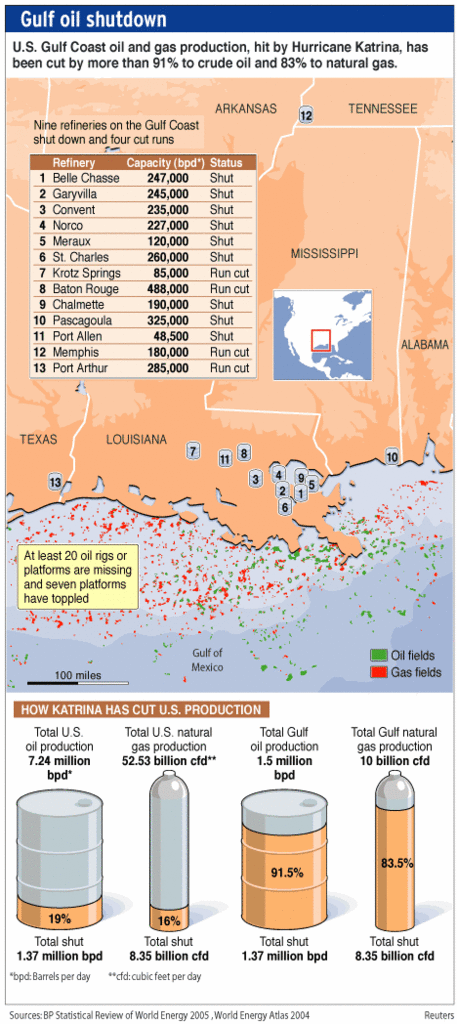
But what scares me more is this:
"The immediate big hit is from the loss of that 10% of U.S. refining capacity. The world's refining system is stretched taut, and gasoline, diesel and jet fuel now teeter on the brink of short supply. The shortfall was accentuated by the shutdown for part of the week--due to electricity loss--of the two major pipelines that carry refined products from the Gulf Coast to the Southeast and the Mid-Atlantic states. That is why wholesale gasoline prices shot up 60 cents in four days. The shortfall will be made worse if panicked motorists rush to fill up. In that case, stations would be drained, only further fueling the scramble."
{{...snip}}
"Some of the refining capacity may come back quickly, while flooding may put some out of commission for some time. Increased product imports from Europe, the Caribbean and Latin America can help offset the losses, but that will take weeks."
Signs of hope, but underneath this commentary is the desparation of shortage. Gas shortages and electricity shortages in the United States are not pretty things to experience. I don't think they know yet if they can make up for the refineries being knocked out. I don't think they know yet if they can get these stations back online or get the crude oil to the other refineries or work the other refineries to the max.
Then there is the pipeline itself. Which seems to be working now, but I've read conflicting reports. But the thing that intrigued me and scared me the most this week was an MSNBC commentary on how the pipeline works. I can't find the transcript online, but if I understood what this guy was saying, if the pipeline doesn't come back to full capacity soon, there is no way to get refined gasoline to the pumps or to the electricity generators in the southeastern part of the United States in quantitites sufficient to sustain use. In other words, no gas at the pumps and no electricities in the houses. Anarchy in New Orleans, could be followed by anarchy in Atlanta or Miami.
Group of Feelings Number Four: People reap what they sow, or, "It's not nice to fool mother nature."
This about says it all:
The expanding U.S. population "has migrated to hazard-prone areas — to Florida, the Atlantic and Gulf coasts, particularly barrier islands, to California," noted retired U.S. government seismologist Robert M. Hamilton, a disaster-prevention specialist. "Several decades ago we didn't have wall-to-wall houses down the coast as we do now."
The way America builds too often invites disasters, experts say — by draining Florida swampland and bulldozing California hillsides, for example, disrupting natural runoff and magnifying flood hazards.
"We're building our communities in ways that aren't compatible with the natural perils we have," Miletti said.
The more advanced the nations, the bigger the blow may be.
Terry Jeggle, a U.N. disaster-reduction planner, cites the New Orleans levee system — dependent on pumps that run on electricity produced by fuel that must be transported in. One failure will lead to another along that chain.
"Complex systems invite compounding of complexity in consequences, too," said the Geneva-based Jeggle.
Experts fear more is to come.
More Than One Can Bear
I've spent more time than I should this week watching news video about New Orleans and remembering my life there.
I've spent more time than I should this week reading and listening to the debates about whose fault it is and what terrible and/or brave people there is facing all this.
This coverage and these opinions have ranged from the absurd to the compassionate.
None of it is adequate and most of it is amazingly selfish in nature.
Has anyone noticed the extent of posturing among politicians? I was sickened by the ways in which both sides of the aisle have taken photo-ops and patted each other on the back as people died and people faced shortages.
Was anyone else offended by the Army Reserve sponsoring video clips on CNN's website? I don't have a television and have only watched coverage in public places this week, so I'm not sure how often these ads are running on tv, but I found the military using this tradegy and the coverage of this tragedy as an opportunity to recruit appalling. It wouldn't bother me if they called for people to come as reinforcements, but many young people will be lured into the services this week on the basis of humanitarian missions only to be sent to die in other places, compounding, in my mind, the tragedy even further.
The class and racial aspects of all this are so blatant that even some mainstream sources like the Associated Press have noted it. Brett Favre, after noting that his mother's home was still in tact because of its location, proceeded to say that such storms were an equalizer among classes because one couldn't just buy their way out of the effects. Bullshit! Richer people were in homes and locations that survived the storm. Poorer people lost everything and have no hope of rebuilding. One need only look at how long it took for the relief effort to get to those who needed it most to understand how low a priority they were.
Of course, one need also only look at the coverage of people breaking into stores for supplies to see the classism. White tourists scrounged for food while black people "looted" the same stores and the same items. Look, I don't care if they did take tvs or nikes. First, shoes are shoes and many of these people needed clothing and shoes after being days in wet, soggy clothes. Second, bartering is a distinct possibility in such circumstances. Taking what they believed was valuable may have been survival instinct because getting out of town is getting to safety. Having valuable stuff to trade might be a ticket to that safety. In any case, applying ordinary norms in such an extraordinary circumstance is based upon ignorance at best, or most likely malice and prejudice.
I'm tired of the liberals complaining about this coverage with opening statements like "I am not condoning looting, but..." I don't give a damn about looting. Property is meaningless in this kind of situation and for people to care more about that than the fact that people were dying or being left for dead on the streets is indicative of how sick this society really is. Has anyone noticed that 80% of the city is under water? Most of the material things are gone. Do you really believe that the store owners are going to come back and salvage this stuff amid the disease and ruin that is going to be this place in the weeks to come? Why even give a damn about what is taken and what is not? It is all symbolic because it certainly isn't practical.
I keep thinking about the person who jumped to their death in the dome. People say stupid things at times like these, such as "God doesn't give us more than we can bear." I'm here to tell you that life is unbearable at times. If you've never been in that situation where you weren't sure if you'd survive the stress, the pain, the sheer terror, then shut up! You don't know what you are talking about.
People find ways to survive unspeakable pain in this life. Some people don't survive.
I've watched landscapes that I recognize on video and pictures and read about places I've been and lived this week. I have memories of a city where I became an adult, where I learned to live as a grown-up. The city will never be the same.
I am in shock. But I am also afraid that there is more to bear and more to become unbearable. The effect of this city and the Gulf coast falling apart is going to be felt for a long time to come. This is a beginning, not just an ending.
I must admit I despair especially because I've seen no evidence that much is changing in the attitudes and actions of our so-called leaders and our so-called media. This is a big wake up call and most people seem to be content to hit the snooze alarm and roll over.

 Posts
Posts


